post by Stephen ‘Parky’ Parkinson (2023 cohort)
In academia, it’s all too easy to spend a lot of time and effort thinking about theory, reading other academic’s writing, and focusing on your research design. They’re all important, but sometimes it stops you from poking your head above the parapet and seeing what things are like in the “real world”.
My PhD research looks at how individuals are engaging with the circular economy and to what extent digital technology plays a role. We live in a society that uses too much and throws too much away, and this all takes a big toll on the environment. The circular economy aims to reduce waste by focusing on actions like repairing, sharing, and reusing, instead of always buying new and throwing away. I’ve spent the first two years of my PhD immersing myself in academic debates about the circular economy, and it’s taken me across a whole breadth of topics, including discard studies, Jevons paradox and rebound effects, and ideas of circular citizenship. But the term “circular economy” doesn’t mean much to the average person; it isn’t something most people talk about over dinner. In fact, many haven’t heard of it at all (and who can blame them when academics can’t even agree what it means).
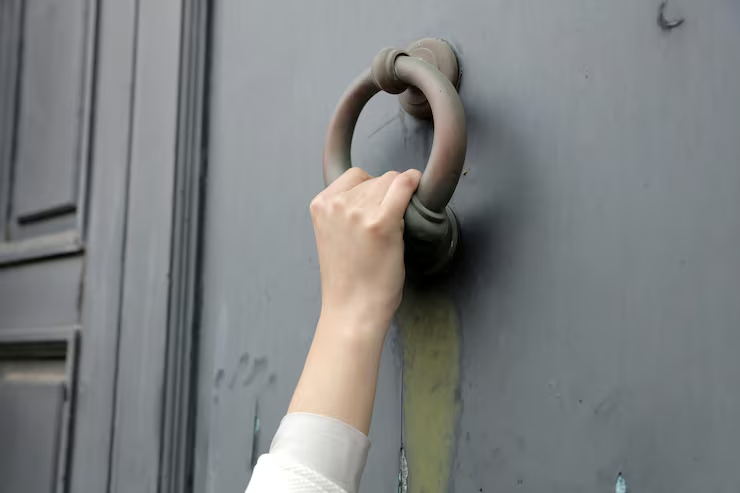
So, what better way to understand what people think than getting out and talking to them? Last summer, I had the chance to do just that by helping Oxfordshire County Council with a doorstep survey in the town of Wantage. It was a great opportunity to talk to people… a lot of people. Over six weeks, the team I was working with managed to knock on nearly 4000 doors and had over 300 conversations.
Why I ended up knocking on doors?
My experience formed part of the Horizon CDT placement module, a three-month opportunity designed to help students develop skills and connect their research to a context outside of academia. My placement with Oxfordshire County Council was organised through their involvement with CircleUp, a Horizon Europe project in which my industry partner, Earthwatch Europe, is also involved. The aim of CircleUp is to explore different ways to engage households with circular economy behaviours; in particular, focusing on how to waste less clothing, electronics, paper and plastic packaging, and food (perfectly aligned with my PhD!) To test this, CircleUp is working with over 100 households in the UK, Germany, Latvia and Norway.
As part of the UK activities in CircleUp, Oxfordshire County Council wanted to run a doorstep household survey with two aims: to understand what circular economy behaviours people already did, and to recruit households to take part in the CircleUp project. Rather than asking about the circular economy directly (a surefire way to prompt blank stares), the questions instead focused on examples of activities to reduce waste run by the local environmental group Sustainable Wantage (for instance, a repair café, library of things, refill shop, clothes swap, and community fridge).
The fieldwork came with its own set of challenges. As usual in the British summer, we spent as much time sheltering from the torrential rain as we did shading from the sun. And each door knock could start a new adventure from (over)friendly dogs, people in the middle of moving house, and others who were keen for a long chat (or rant) about completely unrelated topics. But was all the risk worth the reward?
What I learned from the conversations
I learnt a lot from the placement. It gave me great hands-on experience in every stage of designing and conducting a large-scale household survey. The data collected will also provide really helpful context for the studies I’m carrying out in my PhD. But the biggest learnings weren’t these practical skills, they were the cumulation of experience from each door knocked. Every conversation revealed a different perspective, as much shaped by practical realities and family routines as they were by deeply-held values and beliefs. It reminded me that circular economy behaviours aren’t abstract concepts – they are built on layers of lived experience and personal history, mixtures of habits and impulsive actions, and that often, despite best intentions, behaviour is determined by local infrastructure and other practical limitations.
One of the biggest takeaways I had from the experience was that, although the term circular economy is unfamiliar, the underlying principles of reducing waste through reuse, repair, and sharing are instinctively appealing to a lot of people. Even if people hadn’t heard about community activities like library of things or repair cafes before, once we explained more about them, many really liked the idea and seemed keen to get involved.
At the same time, the conversations could be difficult to navigate because everyone brought their own priorities and interpretations. Once we’d mentioned waste, some people dismissed the whole topic as about recycling and couldn’t see beyond this as the main (or only) way to reduce waste.
Overall, the placement challenged me to think differently, talk about my work differently, and reflect more deeply on the purpose of my PhD. It helped me learn what the circular economy could mean to the people whose everyday habits shape it . And ultimately, it helped me to ask, “what matters to households (and what doesn’t)?”
And for that, nothing beats knocking on a door and having a conversation.