
post by Bogna Liziniewicz (2023 cohort)
Traces of snow welcome me in Scotland. I am surprised to see so many trees, too – actual woodlands covering the hills the train passes by, ascending further north. It is my first time visiting, a surprising coincidence, given that I did my undergraduate degree just eighty miles (or two rail stops) away from the border. Somehow, the direct train to Glasgow never happened to coincide with my travel plans, and so it is only now, years later, that I find myself bound for Scotland.
The second half of February is, no matter how hard I wish it weren’t, cold and grey. I might be an autumnal soul, myself, but several months into this gloomy weather, I am ready for the arrival of spring.
At the same time, I find comfort in the unwelcoming, grey sky, as I wander in solitude around Glasgow after a day of intense – and still, rewarding – public engagement activities.
The latter half of February marks the second instalment of the AI+Us festival, which I already got involved in the month before, back home at Nottingham. Three weeks later, I find myself at the University of Glasgow, my camera roll full of concrete buildings most people would not pause to look twice at; my mind stimulated by conversations.
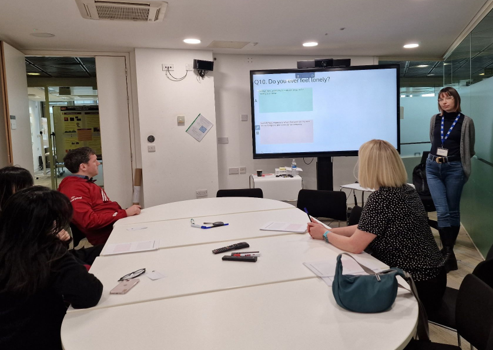
We’re doing the Turing Test. Or, more accurately, a relaxed version of it – only to arrive at the conclusion that it is virtually impossible to tell apart short forms of AI-generated text from those written by a human. The conclusion prompts conversations. I knew I would get to talk to members of the public and AI experts, both, when I agreed to come for the event. Now I’m making use of it, asking what it means for us, humans, exactly and where it is that responsible AI use meets challenges.
The conversation quickly steers to the aspects of my own research on loneliness interventions. Should we – and if yes, how do we – use AI when designing those? Chatbots come to mind. Empathy expressed as trained, a shortcut, a bridge between rebuilding self-confidence and seeking new interpersonal connections being as helpful as it is controversial. I keep wondering about their potential and danger, both; not taking sides, when I listen to the questions and answers that arise between a multitude of topics concerning other uses of generative AI and the challenges thereof.
The day is intense. University students and members of the public show up, group after group entering and exiting the room. The atmosphere is casual – I balance my helping with the delivery of activities and the informal conversations, questions, and ideas that relate to my PhD. I try not to think of the borrowed pens I will never see again.
And in the end, I am glad to have volunteered, even if I only got so much time to gather thoughts for my PhD. The public dialogue, the perspectives expressed by different individuals, whether or not directly related to my research, have all prompted thoughts I want to address at one research stage or the other. AI chatbots are already being proposed and used as therapeutic means of dealing with loneliness. Charities link people to enhance human connection. And I, I sit somewhere between the two, tasked with the necessity to find out how we can use the resources we have, how to be responsible in doing so; and how to make sure it is the person in need that benefits. An event dedicated to public dialogue on research and technology is a good place to start looking for answers.
This activity was funded by the Horizon CDT Small Impact Grant.